Chris Brobeck - Drawings
Drawing is one of those wonderful activities one can do almost endlessly. Tim Folzenlogen - a well known New York representational artist - once commented in an internet newsgroup posting something to the effect that as long as there were people walking the streets of New York he would have endless new vistas to explore. I think that's a sentiment that's shared by most humanist artists - that though we will never solve the mystery of life, exploring it through visual understanding of those around us makes life deeper, richer, more satisfying.
(Note: If you would like to see any of the pictures on this page in greater detail, click on the image. Further information about the drawing is available for some, and there is a variety of resolutions available for most. Feel free to copy them for your own personal enjoyment; for other uses please contact me.)
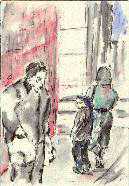
Pencil sketching is one of the easiest, and most accessible methods of drawing, and I hope to have a few works in pencil up soon. But I find myself increasingly drawn to working in pen and ink - partly because it forces a greater degree of care and discipline, but also because one has to learn how to adapt to one's errors. (I do a good deal of adapting.) Sometimes it is simply a rough sketch of an event that occurred during the day - such as this image based on an encounter with one of the many older men who live on the economic edges of Halifax.
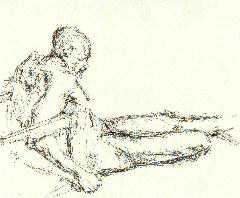
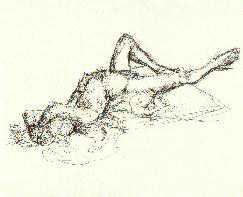
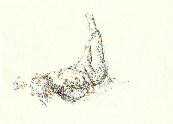
I also enjoy doing life drawing; particularly when
I can work quickly (though not hastily). There's several examples below:
 |
 |
 |
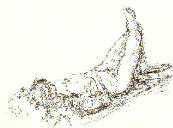 |
The two on the lower row were of the same model in the same pose, before and after a break. I find drawing the same image repeatedly to be an interesting method of study.
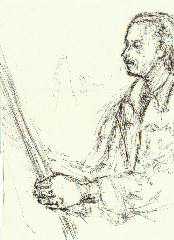
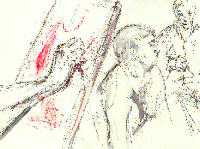
Even so, drawing the model can get rather boring -
particularly when the model holds the pose for a number of hours. In
roomful of artists, however, one should never be short a willing subject!
Hence the following is what results when the Devil finds work for idle
hands:
 |
 |
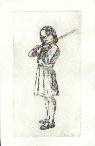
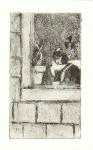
Pen and ink work almost naturally leads to etching - it is the (classical) technique where one has the most control in terms of holding the bulk of a drawing fixed, while experimenting with one or two elements. That's the theory, at least! The reality is - especially for drypoint - the more prints you take the faster your plate degrades, while the ink and even the paper can vary in behaviour on a day-to-day basis.
It does, on the other hand, allow one to do things that would otherwise be frowned on, such as getting absolutely filthy, and playing with sharp objects...
Below are two recent etchings:
 |
 |